
Children > Custody

Where a couple have children younger than the age of majority, decisions must be made as to how the children will be brought up, who they will live with, and how they will be cared for. For many people, custody disputes are one of the most difficult consequences of the end of a relationship.

The chapter will discuss the difference between custody and guardianship and review the legislation which deals with custody. It will also look at the factors which go into an order for custody, the different types of custody order, and the types of people who are entitled to make an application for custody.

Custody and Guardianship

The difference betwen custody and guardianship can be a bit fuzzy. At the most basic level, "custody" can be thought of as having the home where the child usually lives and the day-to-day responsibility for the child, even though more than one parent can have that home, while "guardianship" is having the right to direct the course of the child's life and upbringing; of course, there is some overlap between the rights and obligations associated with having custody and those associated with having guardianship. Having custody usually includes having guardianship, however having guardianship doesn't always include having custody.

Guardianship is the right to play a full and active parenting role in a child's life, including participating in and directing the child's moral, religious and social education, and being involved in matters involving the child's formal schooling, health care, social environment and sports and recreational activities. A person with guardianship can get information from and give instructions to the other people involved in the child's care, such as teachers, doctors, dentists and therapists.

Custody includes all of the rights associated with guardianship plus the right to have physical care and control of the child. While a couple are together, they automatically share the custody of their children.

The following combinations of custody and guardianship are available:

  1. joint custody and joint guardianship;
  2. sole custody and joint guardianship; and,
  3. sole custody and sole guardianship.

It is not possible for the parties to have joint custody while one parent is the child's sole guardian.

Back to the top of this chapter.

The Divorce Act and the Family Relations Act

Both the federal Divorce Act and the provincial Family Relations Act deal with the custody of children, however the Divorce Act applies only to married couples. The Family Relations Act, on the other hand, is available to anyone seeking custody of a child, including married couples and people who aren't the natural parents of a child. While the two acts generally mimic each other, there are a few important differences:

Who is a child?

  • The Divorce Act calls children "children of the marriage," and s. 2(1) of the act defines a child of the marriage to be a child of two spouses who is under the age of majority, or older but unable to withdraw from the care of his or her parents.
  • The Family Relations Act, at s. 1(1), defines a "child" as a person under the age of nineteen, and s. 87 says that adult children can also be "children" for the purposes of the part of the act which deals with child support.

Which act applies?

  • The Divorce Act is only available to married parents or formerly married spouses, and the person making the application must have been "habitually resident" in their particular province for at least one year before the application is made in that province.
  • The Family Relations Act is available to anyone, providing that the child is "habitually resident" in British Columbia at the time the application is made.

Does custody include guardianship?

  • The Divorce Act only deals with custody and access. Under this act, guardianship is a part of having custody, so a person with a Divorce Act order for the custody of a child automatically also has guardianship of the child.
  • The Family Relations Act deals with both custody and guardianship, and orders made pursuant to this act usually provide for custody and guardianship separately. Section 27(4) of the act provides that where an order for custody under the Divorce Act has been made, the custodial parent is also the child's guardian.
  • In general, an order for custody under either act will be considered to include an order for guardianship unless the order separately provides for guardianship.
Statutory Provisions: The Divorce Act

The following are the primary sections of the Divorce Act dealing with custody:

  • s. 2: definitions
  • s. 4: the court's jurisdiction to make custody orders
  • s. 5: the court's jurisdiction to change orders
  • s. 16: custody orders
  • s. 17: variation proceedings
Statutory Provisions: The Family Relations Act

The following are the primary sections of the Family Relations Act dealing with custody:

  • ss. 1, 21: definitions
  • s. 9: interim orders
  • s. 20: changing or cancelling orders
  • Part 2: child custody, access and guardianship
  • s. 24: the best interests of the child are paramount
  • s. 34: who may exercise custody
  • s. 35: custody orders
  • ss. 36, 38: enforcement of custody orders
  • Part 3: out-of-province child custody, access and guardianship orders

Back to the top of this chapter.

Factors in Custody Awards

There are really two sets of factors that the court will consider in making an order for custody: the factors set out in the legislation; and, the additional factors which have developed through the common law.

As far as the legislation is concerned, s. 16(8) of the Divorce Act provides that:

In making an order under this section, the court shall take into consideration only the best interests of the child of the marriage as determined by reference to the condition, means, needs and other circumstances of the child.

Section 24 of the Family Relations Act states that:

(1) When making, varying or rescinding an order under this Part, a court must give paramount consideration to the best interests of the child and, in assessing those interests, must consider the following factors and give emphasis to each factor according to the child's needs and circumstances:
(a) the health and emotional well being of the child including any special needs for care and treatment;
(b) if appropriate, the views of the child;
(c) the love, affection and similar ties that exist between the child and other persons;
(d) education and training for the child;
(e) the capacity of each person to whom guardianship, custody or access rights and duties may be granted to exercise those rights and duties adequately.
(1.1) The references to "other persons" in subsection (1)(c) and to "each person" in subsection (1)(e) include parents, grandparents, other relatives of the child and persons who are not relatives of the child.
(2) If the guardianship of the estate of a child is at issue, a court must consider as an additional factor the material well being of the child.
(3) If the conduct of a person does not substantially affect a factor set out in subsection (1) or (2), the court must not consider that conduct in a proceeding respecting an order under this Part.
(4) If under subsection (3) the conduct of a person may be considered by a court, the court must consider the conduct only to the extent that the conduct affects a factor set out in subsection (1) or (2).

These sections of the legislation set out the criteria which a court must consider in making an order for custody. Some additional considerations have developed from the common law which the court may consider, including the following general principles:

  1. the parent most likely to be granted custody is the person who was the children's primary caregiver during the relationship;
  2. each parent's character, personality and moral fitness may be considered in determining custody, depending on the circumstances of each case;
  3. the court may also consider each parent's mental and physical capacity in determining custody, again depending on the circumstances of the case;
  4. siblings will usually be kept together, although they can be separated in certain circumstances;
  5. where the children are presently in a stable and satisfactory setting, the court will be reluctant to alter the status quo, unless the long-term interests of the children outweigh the benefits of their present stability; and,
  6. the court will generally take into account the preferences of children who are twelve or more years old, but will not be bound to follow those preferences.

There is no hard and fast way to predict the outcome of a battle for custody. Some people believe that the courts will prefer giving custody of children to their mothers; others believe that the courts have adopted a more modern, gender-neutral approach to custody issues. Either way, the critical factor in a custody award is the best interests of the child, and the parent who is obviously the primary caregiver will usually be the person who it is in the child's best interests to remain with.

Custody and Access Reports ("Section" 15 Reports)

Section 15 of the Family Relations Act allows the court to order that an assessment be conducted of each party's parenting abilities and relationship with their children by a mental health professional. These are known as "Section 15 Reports" or "Custody and Access Reports," and a court can require that such a report be conducted whether the action is under the Divorce Act or the Family Relations Act. Section 15 reports are particularly important where the dispute between the parties is especially bitter and unlikely to settle.

The Supreme Court of British Columbia, in a 2001 case called Gupta v. Gupta, described s. 15 reports this way:

"The purpose of a Court ordered s. 15 Assessment and Report ... is to assist the Court in determining the issues before it, including the paramount of issues of what is in the best interests of the children. The section itself contemplates that the person doing the investigation must be approved by the Court, and must be independent or neutral. ... The investigation is carried out for the purposes of the Court, and in the best interests of the children, and not those of the partial parents who are embroiled in what is seen as the dispute of their lives, who generally represent the extremes of every issue, and whose evidence is often found to be coloured to say the least."

When a s. 15 report is required, the court will usually specify a particular psychologist or psychiatrist to conduct the assessment. Ordinarily, the assessor will meet each of the parents separately and give them a battery of basic psychologial tests, and meet them each again in the presence of the children. If the children are old enough, the assessor may speak to the children separately. The psychologist or psychiatrist may also be required to speak to other people who know the couple and their children, including their friends, family and neighbours, or the children's teachers and any counsellors or therapists.

Once the report is prepared, which can take anywhere from two months to eight months, the assessor sends the report to both parties. These reports can be used in two ways: to encourage settlement; and, at trial to persuade the court that one parent is to be preferred over the other. The psychologist or psychiatrist who prepared the report can be called to testify at the trial and will be subject to cross-examination as to how the assessor came to his or her recommendations.

It is important to remember that all the pyschologist or psychiatrist does is present his or her recommendations and the evidence — such as test scores and interview observations — that he or she relied on in coming to those recommendations. At the end of the day, it is always up to the judge to decide who the children will live with. A s. 15 report is merely the assessor's recommendation to the court based on his or her particular expertise as an experienced psychologist or psychiatrist, it is not a binding or final decision of the issues.

A list of some of the psychologists and psychiatrists who prepare s. 15 reports in this province is provided in the section Resources & Links.

Views of the Child Reports

A "views of the child report" exactly what it sounds like: it is an assessment of the child's own preferences with respect to which home the child would like to live in, and how and how often the child would like to see each parent. These assessments are usually conducted by a psychologist but can be prepared by anyone designated by the court for the purpose, including family law lawyers, family justice counsellors and therapists.

A views of the child report is a kind of condensed custody and access report, and are also prepared pursuant to the authority given by s. 15 of the Family Relations Act. The assessor will usually meet with the child once, and sometimes more than once. The assessor may or may not collect additional information from the parents.

These sorts of reports are generally only appropriate when:

  1. the parents understand that the views of the child are only one part of the whole picture;
  2. the child is more than seven years old;
  3. the judge wants to hear from the child but does not want to interview the child him- or herself.

They won't be appropriate where the child is not capable of expressing his or her preferences or where there are allegations of parental alienation.

Views of the child reports can usually be prepared quickly and cheaply, but are no substitute for a full s. 15 report. Parents who want a views of the child report must understand that these reports are little more than a summary of what the child has told the assessor and do not contain the full reporting, testing and analysis offered by a s. 15 report, particularly where the assessor is not a psychologist or psychiatrist.

It is important to know that the court will not make a decision based only on what the views of the child report says. The child is not making the decision and will not be responsible for making the decision. It's important for the child to know this as well.

Most psychologists and psychiatrists who prepare s. 15 reports will also prepare views of the child reports. Family justice counsellors will also prepare these reports, however they may be too busy to have the report completed in a timely manner. Family law lawyers who prepare views of the child reports will usually advertise that they do so.

Back to the top of this chapter.

Types of Custody Order

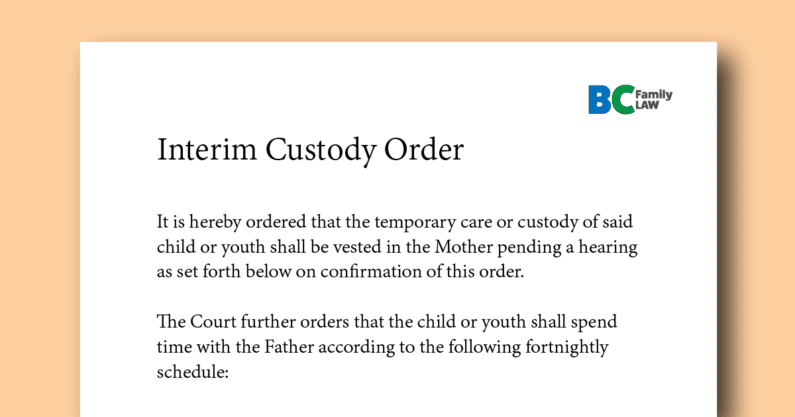
Custody orders fall into one of two headings: they are "interim orders" made after an action has started but before it has concluded; or, they are "final orders" made following a settlement or a trial. In general, any kind of order that can be made on a final basis can also be made on an interim basis.

Interim Orders

Interim orders are usually intended to provide a structure to the legal relationship between the parties and their children which will last until the matter is finally resolved at trial.

An application for interim custody is not meant to be a final determination of the issue, and, while the same considerations are applied in making an interim order as they are in a final order, a greater emphasis is placed on the child's immediate and short-term best interests. As a result, the courts will often preserve the existing situation and leave the child with whichever parent he or she is living with, rather than disturb the child and require a change of homes. In other words, if the husband left the family home when the parties separated, leaving the children with their mother, the court will likely allow that situation to stand, until the final decision is made. In such circumstances, the parent who left will have to prove that for some reason it is not in the best interests of the children to stay where they are, but unless there are some particularly compelling reasons — like alcoholism, abuse or mental illness — for the childen to move, they will usually stay where they are. As a result, both parents should be very careful and consider their options carefully if things come to the point where one parent simply must move out of the family home.

Interim orders can be changed, or "varied." Generally, a parent will apply to vary an interim order where there has been an unexpected change in circumstances which has adversely affected the best interests of the child.

Sole Custody

A parent with sole custody has the child's primary residence and is responsible for the child on a day-to-day basis. Such orders sometimes have the unfortunate effect of dividing the parents into the "custodial parent" and the "access parent."

For some couples, sole custody is ideal. In such cases, one parent, typically the parent who was not the children's primary caregiver during the relationship, has less of a personal interest in being with the children all of the time than the other parent, and is quite content to resign custody. In other cases, the parents live too far apart from each other, or have such a poor relationship with each other, that any other order wouldn't work.

For other couples, sole custody is necessary because it is in the children's best interests, as the other forms of custody require a significant amount of communication and dialogue between parents that is just not practical or possible. Where emotions run too high, and the parties find themselves simply incapable of communicating with each other without fighting and exchanging insults, sole custody may be necessary to shield children from their parents' conflict and give them as stable a situtation as possible.

Joint Custody

An order for joint custody gives each parent custody of the children. In such cases the parents must work together and co-operate in raising the children. The children may still spend more time — sometimes a lot more time — at one parent's home than the other, but both parents remain the children's joint custodians and their joint guardians. It is a basic principle of family law that children should have as much contact with both parents as possible.

It used to be the case that where the parties had trouble communicating with one another, the courts were predisposed to making an order for sole custody. In recent years, this presumption seems to be disappearing, and more and more often couples who are having problems dealing with each other are allowed to share custody, providing that this sort of arrangement is in the children's best interests. The court will generally make such an order despite communication problems, so long as the parents share a fairly common idea of how the children should be brought up and are mature enough not to let their dispute impact on the children.

Whether parents have joint or sole custody depends more on their relationship and approaches to parenting than it does on how much time each parent has with the children. A parent can see the children only on every other weekend, or live in another province altogether, and still have joint custody.

Shared Custody

Shared custody is a kind of joint custody in which the children spend an equal or almost equal amount of time with each parent. With such an order, the children usually spend a certain amount of time with one parent at that home and a similar amount of time with the other parent at their home. These orders can require that the children switch homes every three or four days, every other week, every two weeks, or every month; the amount of time the children spend with each parent will depend on the circumstances of each case, the age of the children, and how the amount of time spent with each parent impacts on the children's best interests.

In many ways, this is an ideal form of custody as the children spend an equal amount of time with each parent, and have the equal opportunity to bond with each parent. Shared custody usually requires that:

  1. the parents live fairly close to one another;
  2. the parents have adequate communication skills with one another;
  3. both parents are able to put the children's needs ahead of their own;
  4. the children are old enough to be able to tolerate the disruption of living in two different homes; and,
  5. the arrangement is in the best interests of the children.

Of course, there is a down side to this sort of order. The strain of communicating so frequently with the other spouse can be a bit of a burden; it can be costly to maintain a full set of clothing, shoes, toiletries and supplies at each house; and, no matter what, the children are still moving from one house to another each week.

Split Custody

In this type of custodial arrangement, one or more of the children live with different parents, and each parent will have custody of those children who are in his or her care. This is a fairly drastic form of order as it requires the separation of brothers and sisters who may grow apart from each other as time passes.

These sorts of orders are only made where there is clear evidence that it is in the best interests of all of the children to fracture the family unit, such as when the siblings are constantly fighting and at each other's throats, or when one child has a particular attachment to a parent not wholly shared by the other children. In such cases, a s. 15 report confirming that the children ought to be split apart is essential.

Back to the top of this chapter.

Who Can Apply for Custody

In general, anyone who has a connection to a child may apply for custody of the child. Normally, the people who apply for custody are the natural parents or legal guardians of a child, but grandparents or other adults involved with the child may apply for custody if they wish.

The Divorce Act

According to s. 16(1) and (4) of the Divorce Act any person or persons can be granted custody of a child. Where that person is not a spouse or a former spouse, according to s. 16(3), he or she must apply to the court for permission to apply for a custody order. The court may grant custody to non-parents.

The Family Relations Act

According to s. 35(1) and (1.1) of the Family Relations Act any person or persons can be granted custody of a child, including:

  1. a natural parent;
  2. a grandparent of the child;
  3. other relatives of the child; and,
  4. people who are not related to the child.

Applications by People Other than Parents

While both acts make it clear that anyone can apply for the custody of a child, the court will presume that the biological and step-parents of a child are entitled to raise their own children unless there is a clear reason why this should not be the case. Again, as in all matters touching on children, the court's decision will rest wholly on what is in the best interest of the child, rather than the interests of the parents or those of third parties.

The common law rules dealing with competing custody claims between a non-parent and a parent are as follows:

  • The natural parents of a child have a prima facie right to the custody of that child, except where they have abandoned the child or demonstrated a serious lack of fitness to have custody, such as in the cases of abuse or neglect.
  • Custody should only be given to third parties when the natural parents are unwilling, unable or unfit to care for the child.
  • The wishes of the birth parents should be heeded unless there is a serious reason why they shouldn't be, as in the case of a threat to the child's health and safety.

The common theme here is that there must be a real and substantial concern about the fitness of the natural parents' ability to care for a child before that child is taken away and given to a third party.

More information about the interests grandparents and other non-parents may have in a child is set out in the first chapter of this section.

Back to the top of this chapter.


Site Navigation

Continue to the next chapter: Children > Guardianship.
Go back to the start of this chapter.
Go to the first chapter in this section.
Go to the start page of this website.

Section Menu

The Legal System · Alternatives to Court · Child Support · Spousal Support
Family Assets · Family Agreements · Marriage & Divorce · Same-Sex Couples
Unmarried Couples · Other Family Law Issues · Breaking News

Resources Menu

Site Map & Index · Legislation · Resources & Links · Definitions · Feedback
How do I ? · About the Author · Reviews & Write Ups · Help!


Please ensure you take the time to read these important legal notices.

Terms of Use · Copyright Notice · Disclaimer · Privacy & Confidentiality · Press Kit

Copyright © 2001-2007 John-Paul Boyd. All rights reserved.

Click here to go back to the start page. The Legal System Alternatives to Court Children Children > Parenting After Separation Children > Custody Children > Guardianship Children > Access Children > Making Changes Children > Alienated & Estranged Children Children > Q&A Child Support Spousal Support Family Assets Family Agreements Marriage, Separation & Divorce Same-Sex Couples Unmarried Couples Other Family Law Issues Breaking News Site Map & Index Legislation Resources & Links How do I ? Feedback Definitions About the Author Reviews & Write Ups Help! Press Kit